
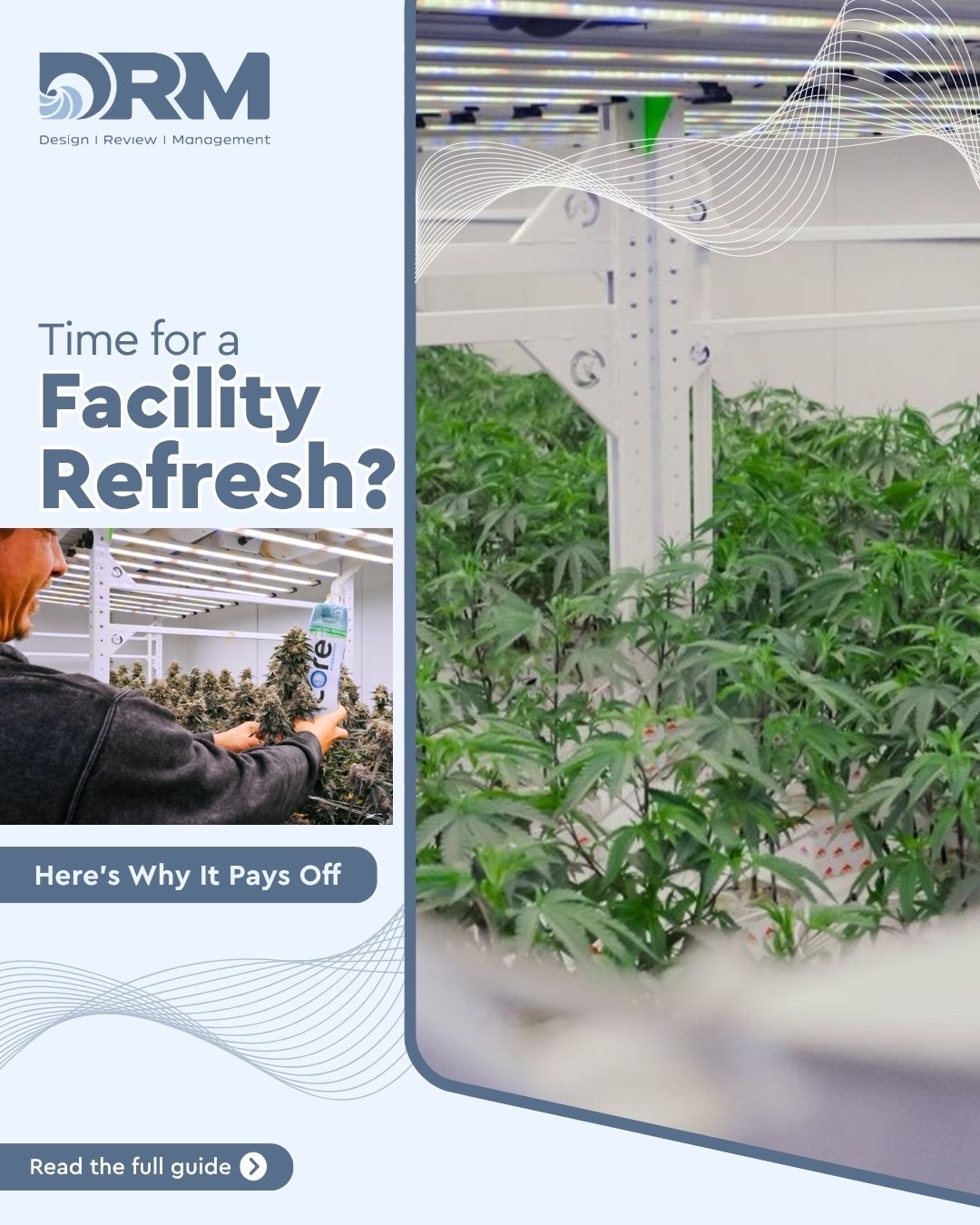
Why a Grow Facility Facelift Pays Off
If you’re running a cannabis grow facility, “good enough” isn’t good enough anymore. Between evolving regulations, rising customer expectations, energy costs, and operational efficiency pressures, there are several signals that your facility may need a refresh, along with the risk of falling behind competitors who’ve already modernized their systems. At DRM, we help growers recognize those signs early and reap the rewards when they act. We don’t sell equipment. We offer knowledge and credible experience built through 1,000+ cannabis facilities designed, 15M+ sq ft, and the growers we’ve worked with side by side as they push the industry bar higher.
Signs Your Grow Facility Is Ready for a Refresh
Declining Crop Quality or Consistency
If terpene potency is dropping, crop loss is climbing, or batch-to-batch variance is higher than expected, environmental control systems (lighting, airflow, HVAC, humidity, CO2) may be poorly installed, aging, or miscalibrated.
Rising Energy and Utility Bills
Old lighting systems (non-LED or inefficient HID), deteriorated or insufficient insulation, outdated climate control, and poor airflow all cost money. If energy costs per unit of yield are climbing, your facility likely isn’t operating as efficiently as it should be. On one facility, swapping outdated HID lighting and fixing airflow cut the utility bill by a third, no equipment overhaul, just fixing what was already sized wrong.
Regulation or Compliance Changes
Many jurisdictions periodically update cannabis regulations covering environmental controls, safety, building code, odor control, and wastewater management. A facility that doesn’t meet new requirements may need a refresh, and stricter enforcement often turns what was optional into mandatory.
Operational Bottlenecks and Workflow Inefficiencies
If workers are navigating awkward layouts, plant flow is constantly disrupted, tasks are double-handled, or cleaning and sterilization is difficult, productivity and profitability are likely suffering. A well-designed facility has logical zones (mother, clone, veg, flower, dry, trim, and processing), clear walkways, and food-safe, antimicrobial surfaces that support easy decontamination.
Outdated Equipment and Technology
Sensors, automation, environmental systems, fertigation, and standard operating procedures that are obsolete or failing increase the risk of crop loss, disease, and inconsistency. Modern controls improve precision and reduce overhead.
Negative Feedback or Reputation Creep
Customer complaints, poor lab results, or quality issues can signal that a facility’s performance, or even its appearance, is slipping. Facility cleanliness, organization, and brand-aligned aesthetics all affect buyer confidence.
Capacity and Scalability Limitations
If you want to expand but your facility’s structure, utility capacity, or layout makes that difficult or costly, it’s time to refresh with scalability in mind. Capacity constraints are far easier to address proactively than reactively.
Safety, Hygiene, and Pest Control Issues
Old materials, cracks, leaks, poor airflow, inadequate separation of zones, or insufficient ventilation can all lead to mold, pests, or contamination. These are serious risk factors in any grow facility and shouldn’t be treated as cosmetic concerns.
Benefits of Refreshing Your Grow Facility
When a facelift or refresh is done intelligently, the gains typically show up across several dimensions:
- Improved crop quality and yield consistency: optimized lighting, climate control, and better workflow help maintain ideal conditions from clone through flower processing
- Lower operating costs: upgrading to more efficient lighting, better HVAC and dehumidification, and improved insulation reduce utility bills, while automation and better layout reduce labor and waste
- Compliance and risk management: meeting current regulatory requirements helps avoid fines or forced shutdowns, and proper design supports safety, hygiene, access control, and environmental compliance
- Enhanced brand reputation: a clean, modern, efficient facility sends trust signals to customers, investors, and regulators, and can improve lab results and open up premium markets
- Operational efficiency and employee satisfaction: well-designed workflows mean fewer bottlenecks and faster turnaround, and employees working in organized, safe, clean environments tend to be more productive
- Scalability and future-proofing: building infrastructure with expansion in mind (utility capacity, layout flexibility, modular systems) allows growth without costly retrofits
- Sustainability and environmental responsibility: better systems reduce energy consumption and waste, which often aligns with available incentives, grants, or rebates
What a Refresh Might Look Like
- Retrofitting lighting to LED with optimized spectra
- Upgrading HVAC and dehumidification systems and sensors
- Reworking facility layout: separating growth zones, improving walkways, reorganizing benches, and simplifying cleaning and sterilization
- Improving insulation, leak sealing, and waterproofing
- Adding or upgrading automation, environmental monitoring, and fertigation systems
- Cosmetic improvements: flooring, walls, signage, and safety markings
How DRM Helps
DRM does more than draft blueprints. Here’s how we help evaluate and execute a strategic refresh:
Audit and assessment. We walk through your facility to review metrics, operational flow, utility usage, and compliance status as part of a facility audit and assessment, identifying weak points before any design work begins.
Customized design plan. Based on your goals, whether that’s quality, compliance, cost savings, or growth, we develop a customized design plan that addresses layout improvements, sensible equipment upgrades, and both visual and strategic changes.
Cost and benefit analysis. We help quantify the payback: expected energy savings, yield improvements, and labor or operational savings, so a refresh decision is based on numbers rather than guesswork.
Project management and implementation. From connecting you with trusted equipment suppliers to coordinating with contractors on a realistic implementation timeline, we manage the refresh from planning through construction so disruptions to your ongoing operation are minimized.
Support and monitoring. After the refresh, we monitor results, adjust systems as needed, and provide continued support to help your newly optimized facility perform consistently.
Conclusion
If any of the warning signs above sound familiar, whether that’s rising costs, inconsistent product, regulatory risk, or a messy workflow, it’s worth acting sooner rather than later. A strategic facility refresh is an investment that tends to pay off through better yields, better margins, and improved long-term competitiveness.
Ready to see what your grow facility could become? Contact us for a facility evaluation and a design plan tailored to your needs.
Frequently Asked Questions
How do I know if my grow facility actually needs a refresh, rather than minor maintenance?
If you’re seeing multiple warning signs at once, such as rising energy costs alongside inconsistent yields or workflow bottlenecks, that’s a stronger signal than any single issue on its own. A facility audit can help distinguish between a maintenance fix and a genuine design-level refresh.
Can a grow facility be refreshed without shutting down operations entirely?
In many cases, yes. Phased refresh plans that address one zone or system at a time can allow parts of a facility to remain operational while other areas are upgraded, though the right approach depends on the scope of work and your facility’s layout.
How long does a typical grow facility refresh take?
Timelines vary significantly based on the scope, whether it’s a targeted upgrade like LED retrofitting or a broader layout and systems overhaul. A facility assessment is usually the starting point for building a realistic project timeline specific to your facility.
What's the difference between a facility refresh and a full rebuild?
A refresh typically upgrades existing systems, layout, and equipment within the current building footprint, while a full rebuild involves reconstructing the facility from the ground up. Most operators pursue a refresh first, since it addresses the underlying issues at a fraction of the cost and disruption of a full rebuild.


